Miao Fuquan
The Dark ForestMiao Fuquan is a Shanxi coal boss, a wealthy but socially unpolished man whose life links private calculation to the immense pressures of the Trisolar Crisis. As a neighbor of Zhang Yuanchao and Yang Jinwen in Beijing, he gives the crisis an ordinary human scale: while governments debate humanity’s future, Miao worries about money, family continuity, physical shelter, and the place where his own body will finally rest. His eventual burial two hundred meters underground is both a practical act of resistance and an ironic monument to how little any individual can control in a changing world.
Identity and Background
Miao Fuquan is a few years younger than Zhang Yuanchao and lives in the same building as Zhang and Yang. He runs a considerable number of coal mines in Shanxi and owns a larger home elsewhere in Beijing. The apartment in the neighbors’ building serves mainly as a place to keep a Sichuan woman who is about the same age as his daughter. This arrangement initially contributes to the Zhang and Yang families’ dislike of him, as does the disorderly way he leaves things in the hallway.
Their judgment gradually changes. Although Miao is described as somewhat vulgar, he proves decent and friendly, and after building management resolves one or two disputes, the three households establish a stable harmony. His wealth and business background distinguish him from the retired chemical-plant worker Zhang and the retired middle-school teacher Yang, but the shared building turns those differences into an everyday association rather than a formal social hierarchy. Miao’s nickname, “Lao Miao,” belongs to this familiar neighborhood world: he is addressed less as a remote industrialist than as a recognizable, occasionally exasperating neighbor.
Miao claims to have handed his business affairs over to his son, yet he remains busy and rarely spends time in the apartment. In practice, the three-bedroom home is usually occupied only by the Sichuan woman. This divided domestic life reinforces his characterization as a man whose resources are extensive but whose presence is intermittent. His property, mines, family, and personal arrangements all exist in several places at once, while the apartment becomes the small social space in which he is known by Zhang and Yang.
The Neighborly World of Crisis
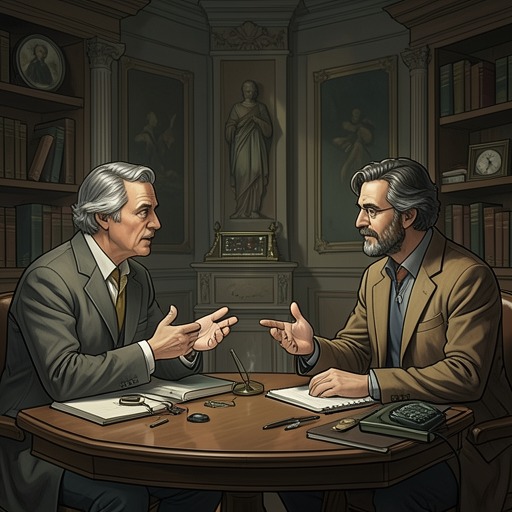
Whenever Miao returns, he invites Zhang and Yang to drink at his apartment. The Sichuan woman prepares a sumptuous feast, making the gathering a recurring ritual of food, alcohol, gossip, and uneasy interpretation. The feast does not suspend the crisis; instead, it gives the crisis a room, a table, and three aging men who try to understand events through their own experience.
During one such gathering, Zhang raises Miao’s visit to the Construction Bank that morning. Miao explains that people were being trampled to death at banks, with crowds packed three deep at the counters. The detail reveals how global catastrophe has entered the financial system and the bodily life of ordinary citizens. Miao is not presented as a detached observer of economic panic. He has gone to withdraw money himself, and his knowledge comes from having entered the crowd at the moment when public confidence is breaking down.
Miao then tells Zhang and Yang that information he had passed on the telephone is reliable: there is an escape fund. The phrase shifts his role from convivial neighbor to conduit of alarming private intelligence. He possesses access to money and business networks, but what matters is not merely his wealth. He understands that financial resources may become useless unless they can be converted into a place in humanity’s struggle to survive. His rumor therefore connects the bank panic to the larger prospect of an organized Human Escape Plan.
When Shi Xiaoming later discusses the plan with Zhang, he frames it as an international effort to preserve family lines, the Chinese people, and humanity itself. Miao’s earlier warning acquires a broader significance in that conversation. The rumor is not simply a local scam or a rich man’s private scheme; within the crisis atmosphere, it belongs to a world where government assurances can reverse within weeks and where ordinary people must decide whether official statements or survival calculations deserve greater trust.
Wealth, Pragmatism, and Family Survival
Miao’s understanding of catastrophe is practical rather than theoretical. He does not appear as a scientist or strategist, and the available evidence does not give him a comprehensive doctrine about the Trisolaran threat. Instead, he responds to the crisis through tangible resources: bank deposits, mining property, family connections, and access to underground works. His intelligence is situational. He notices what crowds are doing, what money may become, and what physical spaces might offer protection.
That practicality also carries an ethical ambiguity. Miao’s wealth derives from coal mining, an industry represented through ownership and abandoned workings rather than through abstract financial capital. His private escape concerns exist beside the broader problem of who will be saved and who will remain. Yet the narrative does not reduce him to selfishness. His concern for the continuation of his family line resembles the motives attributed to ordinary people more generally, and his later instructions to his son show that he imagines survival as a family obligation extending beyond his own death.
His relationship with the other two neighbors also complicates any simple picture of class isolation. Zhang and Yang initially reject him because of his vulgarity, his mistress, and his disruptive habits, but ordinary contact produces recognition. Miao can be crude and still be decent; he can be a coal boss and still participate in a neighborhood friendship. The three men’s gatherings create a small social compact inside a society whose larger unity remains fragile. Their intimacy is not based on shared occupation or ideology, but on proximity, repeated hospitality, and the mutual need to speak about frightening events.
The Underground Grave
Near the end of his life, Miao proposes an answer to the problem of burial in a future threatened by the Trisolarans. When Zhang says that he will be buried in the soil of Earth, Miao suddenly becomes excited and gestures for the others to move closer, lowering his voice as though the sophons might hear. The gesture is comic, fearful, and revealing at once. His response to cosmic surveillance is not a philosophical argument but a secret whispered among old neighbors.
Miao explains that he has many empty mines in Shanxi. His small pit mines are not deep enough by themselves, but several connect to major state-owned mines. By following abandoned workings, one can descend roughly four hundred meters below ground. He imagines blasting the shaft wall so that the Trisolarans will be unable to reach the grave. The plan transforms industrial infrastructure into a defensive and funerary architecture. The mines that made his fortune become, in his imagination, the last refuge for his body.
The plan also displays the limits of his reasoning. Miao does not claim that a mine can save civilization or defeat the Trisolaran threat. He seeks only a depth sufficient to protect one grave. His proposal is therefore modest beside the planetary scale of the crisis, but that modesty is precisely its force. He refuses to let the abstraction of humanity’s future erase the concrete question of how an individual should meet death. The underground chamber becomes a private version of the survival projects debated by states and international institutions.
Death, Burial, and Narrative Significance
Miao is the first of the three Beijing neighbors to die, passing away at seventy-five. His son honors the plan: he buries Miao two hundred meters down an abandoned mine, blows up the mine wall, and erects a tombstone to preserve the memory of the burial. The realized version is shallower than the roughly four-hundred-meter depth Miao had described as possible, but it retains the essential logic of his design. His final request is carried out not as fantasy but as a material family duty.
Miao’s will assigns the tombstone a future purpose. The last generation before the Doomsday Battle is supposed to clear it away, and if humanity wins, the stone may be restored to its original location. The instruction makes his grave a conditional monument, tied to a future historical judgment. Its meaning depends on an outcome Miao will never see: defeat would leave the burial hidden, while victory would permit the family and its descendants to return the marker to the open world.
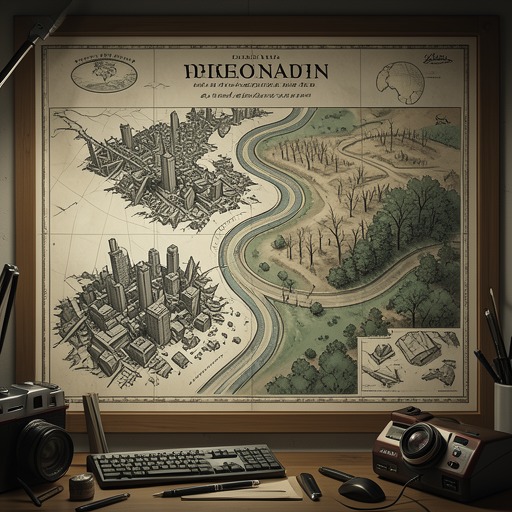
That promise is not fulfilled. Less than half a century after his death, the land above the mine shaft becomes a desert. The tombstone disappears, the location of the mine is lost, and Miao’s descendants cannot be bothered to search for it. The failure is more severe than the simple loss of a family memorial. The underground refuge that seemed to promise endurance is erased by time, landscape, and indifference. Miao prepared for hostile extraterrestrials, yet the grave is defeated by a slower combination of environmental transformation and human forgetfulness.
Miao’s fate gains additional meaning beside the contrasting deaths of Zhang Yuanchao and Yang Jinwen. Zhang dies of illness at eighty and is cremated, his ashes placed in an ordinary slot in a public cemetery. Yang lives to ninety-two, and the alloy vessel containing his remains travels out of the Solar System at the third cosmic velocity, consuming all his savings. Miao chooses neither Zhang’s ordinary civic burial nor Yang’s costly passage into the cosmos. He chooses the Earth beneath an industrial landscape, only for that place to vanish. Through him, the narrative shows that historical scale does not abolish individual wishes, but neither does personal ingenuity guarantee that those wishes will remain legible to the future.